

Hayes Ferguson is a clinical professor and director of the Farley Center for Entrepreneurship and Innovation at Northwestern University.
As Northwestern University navigates steep cuts in federal funding and other financial challenges, the Farley Center for Entrepreneurship and Innovation is more committed than ever to practicing what we teach: embracing flexibility, resilience and creative problem-solving.
We paused our Bay Area Quarter, in which undergraduates spend two months in San Francisco, immersed in startup and Big Tech culture. While it’s disappointing not to offer the popular program this year, it’s prompted us to focus more on innovation happening elsewhere, including in our own backyard.
This winter, we are launching a new class featuring leaders from early-stage companies and global enterprises that are harnessing artificial intelligence to transform their industries. Notable guest speakers include an executive from Chicago-based Tempus, which is applying AI in precision medicine for cancer care, as well as a representative from United Airlines, who will discuss leveraging AI for predictive maintenance, baggage tracking and more.
We continue to offer our acclaimed NUvention classes, where cross-disciplinary student teams seek to solve problems in a range of industries, from media to health care. Among the NUvention class projects that have turned into real-world ventures is Lilac, which has raised $300 million to develop lithium extraction technology to power clean energy.
Alumni are stepping up to offer support. One donor is interested in catalyzing tech innovation in journalism, which of course is close to my heart. As a result, we’re exploring an initiative that would enhance the work we already do with the Medill School of Journalism.
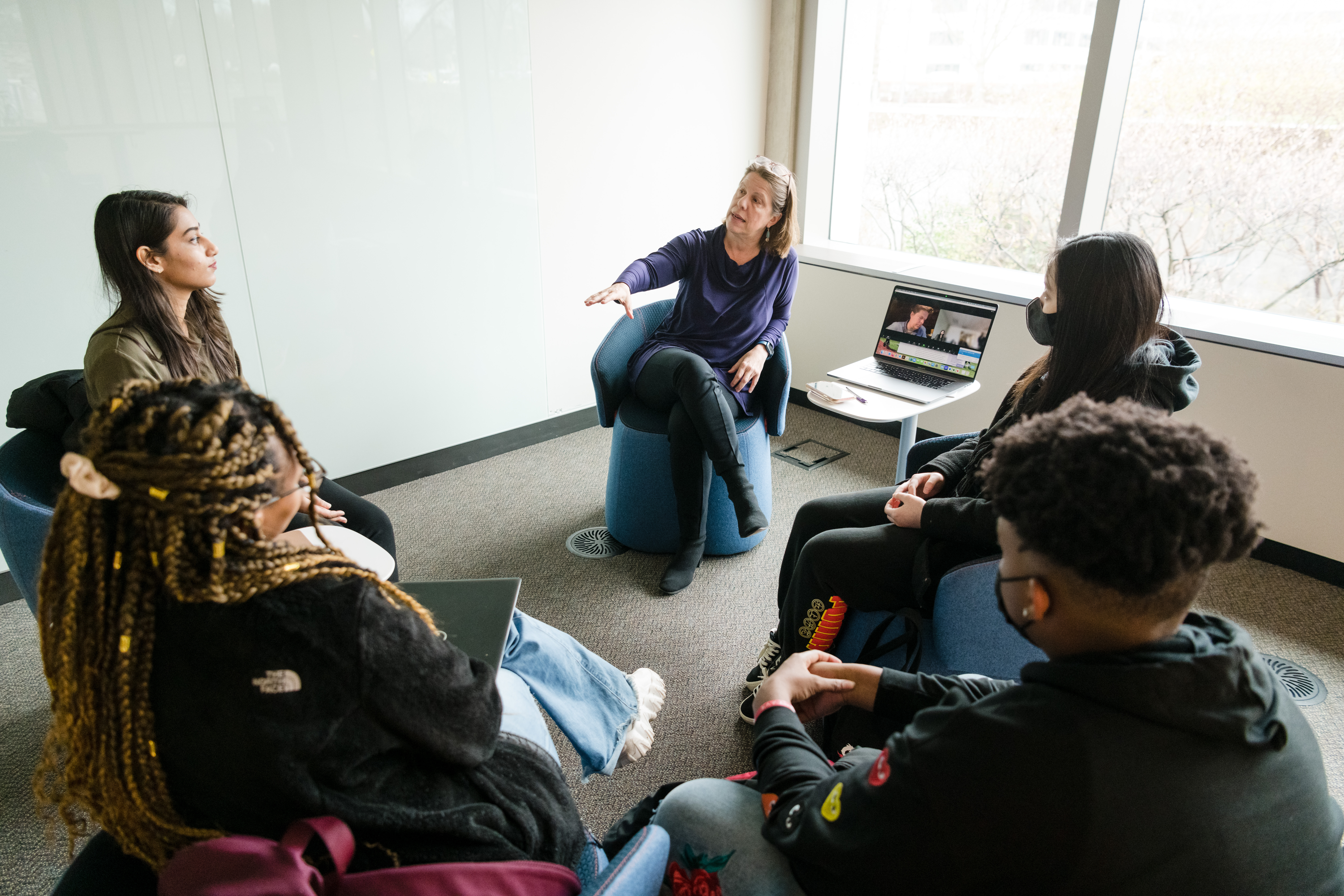
Students are engaging not only to tackle complex world challenges, but also to prepare themselves for the rapidly changing job market in which the kinds of roles our graduates have typically landed — in consulting, banking, you name it — are increasingly hard to find, and far from secure. Launching a new business today therefore seems less risky, relatively speaking. And that’s good for innovation.
I am inspired by our students’ determination to learn not just how to succeed as individuals, but how to make a difference more broadly. As we persevere through uncertain times, there is reason for optimism: by nurturing innovation, adaptability and purpose, we are preparing the next generation to thrive, no matter what the future holds.
This article is part of Rising to Meet the Moment, a series from the Fall 2025 issue of the Wallace House Journal, featuring reflections from Knight-Wallace alumni, Wallace House board members and the Livingston Awards community on meeting today’s challenges with focus, resilience and resolve. Read more stories from our series:
Christopher Baxter, “Unexpected hope“
Lynette Clemetson, “Stepping up with focus and resolve“
Hayes Ferguson, “Nurturing innovation, adaptability and purpose“
Stephen Henderson, “Choosing civility“
Samantha Henry, “The future of our profession: student journalism“
Tracy Jan, “News deserts and fewer watchdogs“
Margaret Low, “Game Over? Not a chance.“
Peggy Lowe, “Defunded, but not defeated“
Amy Maestas, “Building trust through community collaborations“
Kunal Majumder, “Defending the right to report“
Seema Mehta, “Why we keep reporting“
Rachel Rohr, “Swift action for the hardest hit“
Gerard Ryle, “We will not retreat“
Laura Santhanam, “Preserving knowledge“
Mazin Sidahmed and Maria Arce, “Training newsrooms to serve immigrant communities“
Celeste Watkins-Hayes, “Bending without breaking: resilience in academia“
Thomas Zurbuchen, “Never let a good challenge go to waste“