
Joseph Sywenkyj is an American photographer of Ukrainian descent who has lived and worked in Ukraine for 20 years.
I arrived in Ann Arbor from Ukraine with my family in August 2024 to begin my Knight-Wallace Fellowship. Air raid sirens wailed as our train pulled out of Kyiv. Days later, I was attending a seminar on Michigan politics and wondering, “What am I doing here?”
By spring 2025, when my cohort set off for three countries of the former Yugoslavia — Croatia, Bosnia and Serbia — I had mostly adapted to life without war. I was looking forward to learning how other war-torn European societies had attempted the difficult transition to peace and democracy.
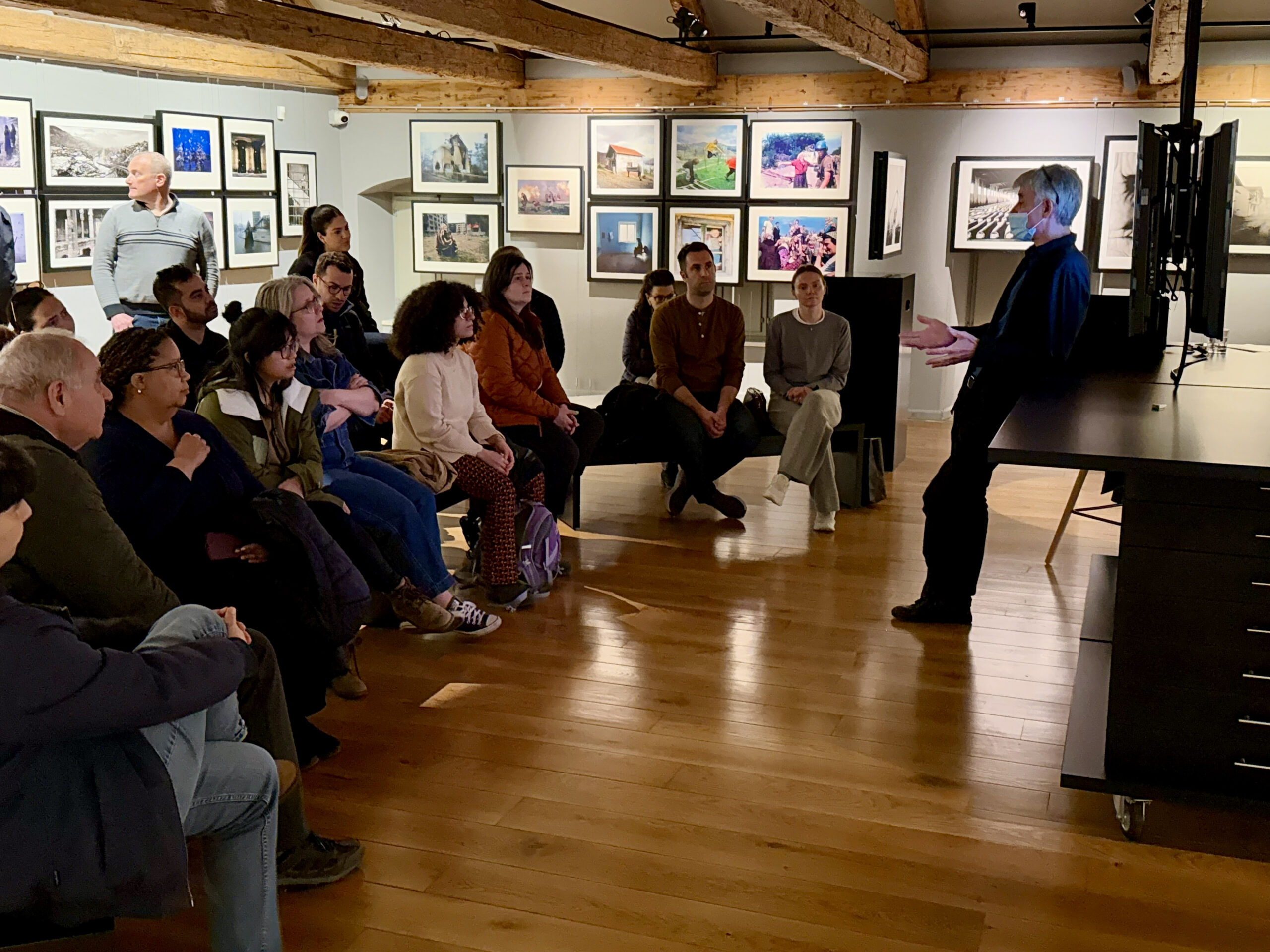
We began our trip in the Croatian coastal city of Dubrovnik, where we were welcomed by our guide, Bosnian photojournalist Ziyah Gafic. We toured a hilltop museum that chronicled the 1991 siege of Dubrovnik and visited photographer Wade Goddard, who ran a gallery dedicated to war photography. I had studied images of the Balkan wars as a young photographer, but to view them well into Russia’s full-scale war against Ukraine was something entirely new. My wife wept as I fought tears and tried to comfort her. It was like looking in a mirror.
Politicians, journalists, activists and religious leaders in Sarajevo helped us understand how selective memory, language and old animosities are harnessed to spark violence and war. Many guest speakers had warnings to share. Aida Čerkez, who was the Sarajevo bureau chief for the Associated Press during
the war, recounted the mass denial before the Serbs began their 1992 attack. She cautioned: “Try to resist the denial, so you can recognize it in time to react. … You cannot save the world. But what you can do, privately and professionally, is position yourself toward the problem.”
The most haunting part of our trip was visiting Srebrenica, where Bosnian Serb forces murdered more than 8,000 Bosnian Muslims, most of them men and boys, while United Nations peacekeepers failed to act. We toured the cemetery and memorial center with curator Azir Osmanović, who survived the 1995 genocide at age 13. He told us more Bosnian Serbs deny the genocide today than they did in the 1990s. As a Ukrainian, I took note of the work we must do to commemorate the victims of Russia’s war against us in the years ahead.
We then traveled to Belgrade, the capital of Serbia, where I was surprised to feel a sense of hope. Our guide, Serbian photojournalist Marko Drobnjakovic, introduced us to courageous investigative reporters and election observers. And we observed peaceful, student-led protests against corruption,
which had spread throughout the country. We were witnessing history in action.
I remain inspired by the people we met, working tirelessly to heal wounds of war and develop more open, accountable and democratic societies.